Tag Archives: jihad

Al-Qaeda in Syria Condemn Jaysh al-Islam for East Ghuta Infighting

By Kyle Orton (@KyleWOrton) on 4 May 2017

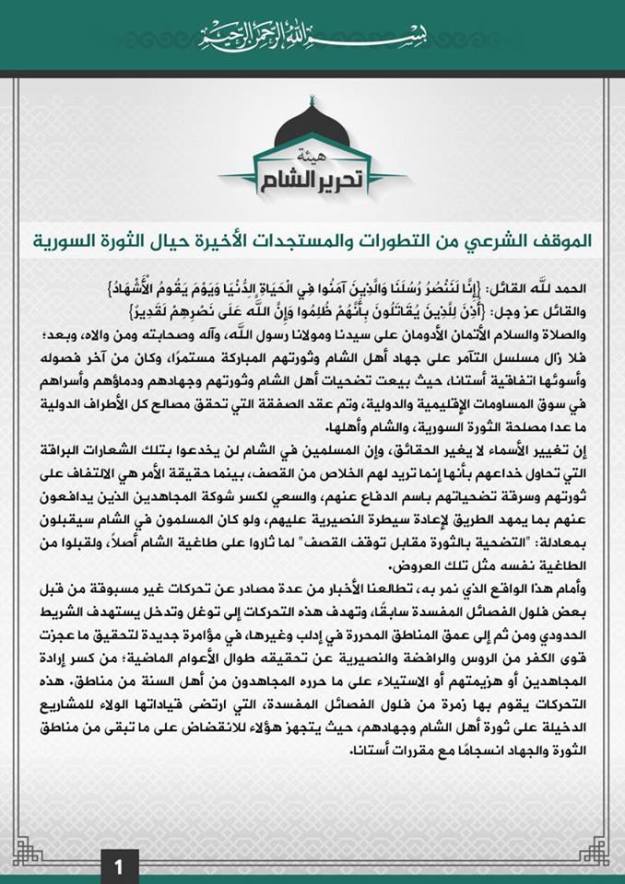
HTS statement on Jaysh al-Islam, 4 May 2017

Hay’at Tahrir al-Sham (HTS), the restructured al-Qaeda branch in Syria, put out a statement today on the intra-insurgent clashes that began on 28 April in the besieged enclave of East Ghuta, the suburbs east of Damascus, between Jaysh al-Islam on one side and HTS and Faylaq al-Rahman on the other. An old al-Qaeda hand, Maysar al-Jiburi (Abu Mariya al-Qahtani), has already commented on this. Now HTS’s General Shari’a Council has released a statement “concerning the ongoing events in Eastern Ghuta”. The statement, translated by al-Maqalaat, is posted below. Continue reading

Al-Qaeda Aligned Jihadist in Syria Condemns Rebel Group Jaysh al-Islam

By Kyle Orton (@KyleWOrton) on 2 May 2017

Maysar al-Jiburi (Abu Mariya al-Qahtani), on Twitter as @alghreeb, is an Iraqi and long-time operative of the Islamic State (IS), who was sent into Syria to set up IS’s secret wing, Jabhat al-Nusra, in 2011. After al-Nusra split with IS and became al-Qaeda’s official branch in Syria, Maysar remained with al-Nusra and was its deputy until the summer of 2014, when the Deir Ezzor branch of al-Nusra that Maysar led was destroyed as IS poured resources captured in Mosul over the border. Since then, Maysar has been—with Saleh al-Hamawi, another member of the advance party that founded al-Nusra—a kind of dissident, formally expelled from al-Nusra, and more recently has set to work spreading his influence in the Turkish-occupied zone of northern Syria, notably through the Ahrar al-Sharqiya group. With the various moves to rebrand and restructure al-Qaeda in Syria under the banner of Hay’at Tahrir al-Sham (HTS), Maysar has been drawn back into the fold to a degree.

Maysar has now released an essay, “Exposing the Backstabbers Within the Ranks,” condemning Jaysh al-Islam for its attacks on HTS in the East Ghouta area of Damascus beginning on 28 April. Intra-insurgent fighting in the besieged enclave a year ago allowed the coalition of states and militias supporting the Bashar al-Assad regime to considerably shrink the enclave and put it on the path to almost certain defeat. Maysar lays particular blame on Samir al-Kaka (Abu Abd al-Rahman al-Kaka; sometimes transliterated al-Kaakeh), a senior cleric of JAI, for issuing rulings licensing this conduct and compares JAI to IS. Maysar also asks, rhetorically, where the condemnations of JAI are from bodies like the Syrian Islamic Council, given how strongly they responded in January when al-Nusra attacked rebel factions as it laid the groundwork for the HTS merger. Masyar’s essay is reproduced below. Continue reading

Al-Qaeda’s Leader Calls on Syria’s Opposition to Shun the West, Rely on the Jihadists

By Kyle Orton (@KyleWOrton) on 23 April 2017

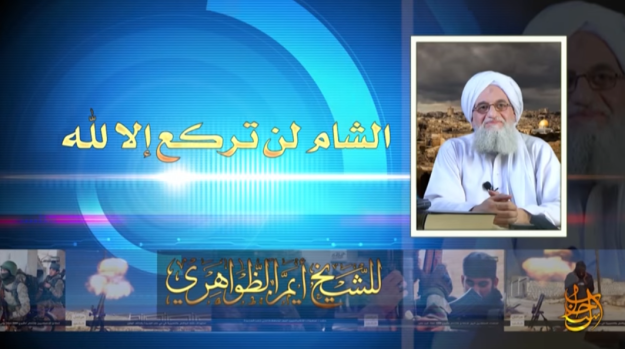
Al-Qaeda’s leader, Ayman al-Zawahiri, released a speech today entitled, “Sham Will Submit to None Except Allah” or “Syria Will Submit to None Except Allah”. The short speech—around five minutes in length—was part of the “Brief Messages” series, “Brief Messages to a Victorious Nation 6,” to be exact. An English transcript of al-Zawahiri’s speech was released by As-Sabha Media and is reproduced below with some editions in transliteration, explanatory notes added, and interesting sections highlighted in bold.
Continue reading

Al-Qaeda in Syria Denounces America, Claims to Be the Revolution

By Kyle Orton (@KyleWOrton) on March 13, 2017

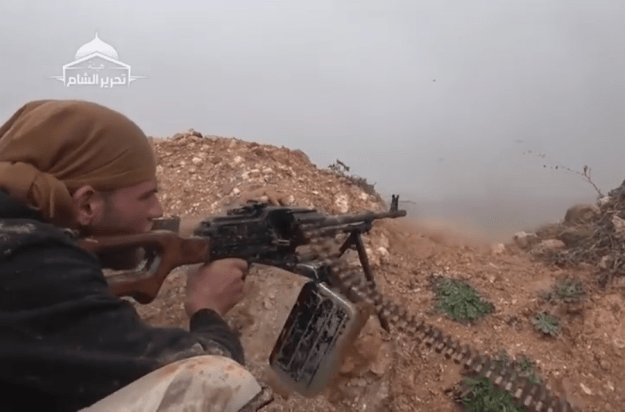
Hay’at Tahrir al-Sham fighter engaging the Assad regime

Michael Ratney, who has been the United States Special Envoy for Syria since July 2015, wrote a public letter , released on 11 March 2017, which labelled all constituent parts of Hay’at Tahrir al-Sham (HTS) as members of al-Qaeda and therefore as terrorists.[1] On 12 March, HTS’s “Administration of Political Affairs”—its newly-minted political office, perhaps evidence of an evolution in HTS’s thinking about an endgame in Syria—issued a statement in reply, which is reproduced below.
Continue reading

Jihadi Cleric Calls for Al-Qaeda’s Leader in Syria To Be Put on Trial

By Kyle Orton (@KyleWOrton) on March 3, 2017

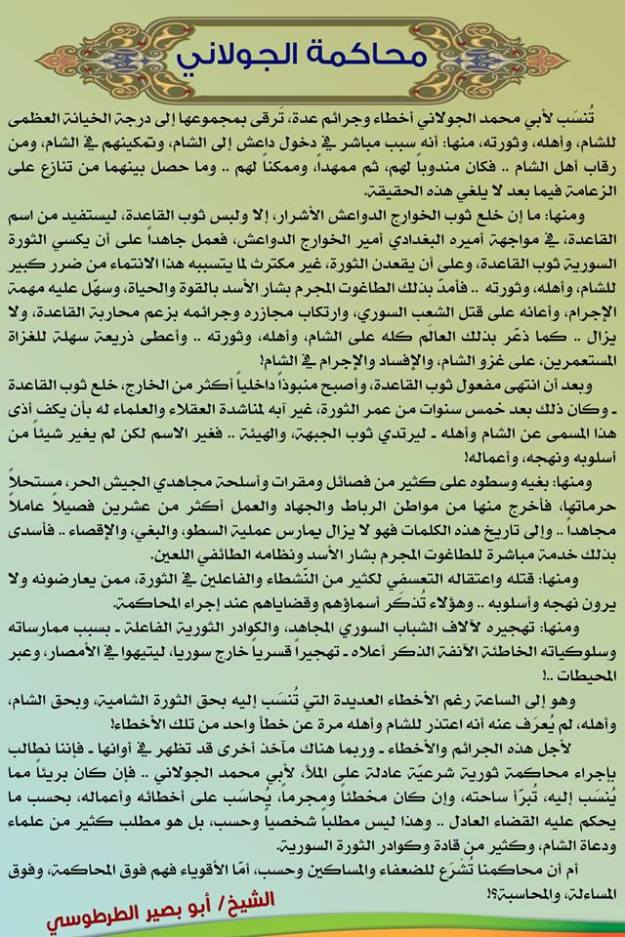
Abdul Munim Halima (Abu Basir al-Tartusi), a Syrian previously based in London, is an important jihadi-salafist scholar, who has diverged from some aspects of jihadism since the 7 July 2005 massacre on the London subway system by al-Qaeda. As the Syrian rebellion has progressed, Halima has departed even further from key jihadi ideologues that continue to take al-Qaeda’s line and support its branch in the country, Jabhat al-Nusra, which formed as a splinter from the Islamic State and has now rebranded itself as Hay’at Tahrir al-Sham. Halima has long expressed the view that al-Nusra and its leader, Ahmad al-Shara (Abu Muhammad al-Jolani), were insufficiently focused on Syrian needs. Halima tended to favour Ahrar al-Sham, an insurgent group with deep links to al-Qaeda, but which has presented its jihadism within a more nationalistic framework. Halima retains sway over Islamist opinion, especially in Syria, so his fatwa today calling for al-Shara to be put on trial for crimes against the Syrian revolution is noteworthy. Halima was especially exercised that the recent attempts by al-Shara to separate his organization from al-Qaeda came so long—and so unconvincingly—after so many had begged him for so long to carry out this policy. Instead, says Halima, al-Shara bullied and dominated the Syrian insurgency in the north under the flag of al-Qaeda, providing the regime of Bashar al-Assad with an alibi for his barbaric conduct in suppressing the insurrection. This is one of several “crimes” Halima says al-Shara should face a court for. The fatwa is reproduced below with some editions to transliteration and syntax.
Continue reading

The Flag of the Islamic State

By Kyle Orton (@KyleWOrton) on January 27, 2017

The Islamic State’s June 2014 declaration that the areas it controlled were the restored “Caliphate” was seen by many as a novel development. In fact, “the State” was declared in October 2006. The next month, the predecessor of the Islamic State (IS), Al-Qaeda in Mesopotamia (AQM), dissolved itself, and a month after that the claim to statehood was expanded upon—while being wilfully ambiguous about the caliphal pretensions—in the first speech by the then-emir, Hamid al-Zawi (Abu Umar al-Baghdadi). Similarly, though confusion remains on the point, it was in this same period that the symbol of the Islamic State, its black flag, was established.

Continue reading

The Founder Lays Out The Islamic State’s Vision

By Kyle Orton (@KyleWOrton) on January 12, 2017

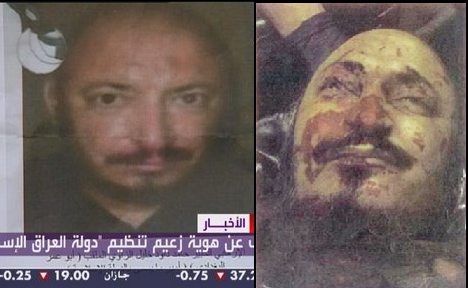
Two of the very few pictures of Hamid al-Zawi (Abu Umar al-Baghdadi) in existence. The picture on the right, taken after al-Zawi was killed in April 2010, is most often used in Islamic State media.

Two of the very few pictures of Hamid al-Zawi (Abu Umar al-Baghdadi) in existence. The picture on the right, taken after al-Zawi was killed in April 2010, is most often used in Islamic State media.

Hamid al-Zawi (Abu Umar al-Baghdadi), the first emir of the Islamic State when it was founded in 2006, gave his third speech—“Say, I Am Upon Clear Evidence From My Lord” or “Say, I Am Made Certain By My God”—on 13 March 2007. An English transcript of the speech was released online by the Jihad Media Battalion and a video of part of the speech was released, entitled, “This Is Our Doctrine”, a neat encapsulation of the speech’s content. The speech is an interesting first-hand statement of what the Islamic State actually believes, and is reproduced below.
Continue reading

Al-Qaeda’s Leader Reiterates the Group’s Ideology, Intent to Strike the West

By Kyle Orton (@KyleWOrton) on January 7, 2017

1

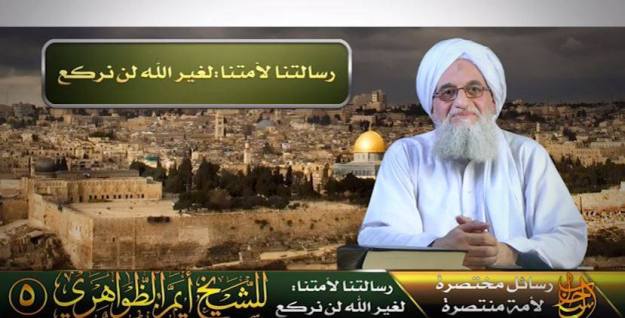
On 5 January 2017, the leader of al-Qaeda, Ayman al-Zawahiri, gave a speech, “To Other Than Allah, We Will Not Bow: Brief Messages To A Victorious Nation, Part 5”. Today, al-Qaeda channels put out an English translation. The emphasis of the speech was restating al-Qaeda’s creed and methodology, specifically as it differs from that of the Islamic State (IS). One noticeable point was al-Zawahiri’s admonition against IS’s genocidal approach to the Shi’a: lay Shi’is should not be harmed, al-Zawahiri says; rather, their leaders should be killed for misguiding them and the masses converted to Sunnism. Al-Zawahiri also reiterates that al-Qaeda remains focused on the West and determined to carry out terrorism against it—regardless of whatever short-term strategic calculations currently have al-Qaeda de-emphasizing this aspect of its worldview and conduct. The speech is reproduced below with some transliteration editions and some sections bolded for emphasis. Continue reading

The Islamic State’s Official Biography of the Caliph’s Deputy

By Kyle Orton (@KyleWOrton) on December 18, 2016

Obituary for Abdurrahman al-Qaduli in the German version of Rumiya, 11 November 2016

Obituary for Abdurrahman al-Qaduli in the German version of Rumiya, 11 November 2016

The forty-first edition of the Islamic State’s newsletter, al-Naba, released within the territory of the caliphate on 30 July 2016 and released online on 2 August, and the forty-third edition (released 13 and 16 August), contained a two-part obituary for Abd al-Rahman al-Qaduli (Abu Ali al-Anbari), the caliph’s deputy when he was killed on 24 March. The obituaries, entitled, “The Devout Scholar and Mujahid Preacher: Shaykh Abu Ali al-Anbari”,[1] make clear that al-Qaduli was one of the most consequential jihadists in the history of the Islamic State movement. Below is a translation, with some interesting and/or important sections highlighted in bold. The biography resolves some long-standing mysteries, and some of the claims are dubious in light of other evidence we have: these issues, and other points of context and explanation, are in the footnotes. The subheadings are mine, added to signpost the narrative and break it up into more manageable chunks.
Continue reading

The Intellectual Roots of the Islamic State

By Kyle Orton (@KyleWOrton) on August 15, 2016

Published at The Wall Street Journal

Sayyid Qutb

Sayyid Qutb

Why did Prohibition in America fail? The Pakistani Islamic scholar Abul Ala Mawdudi argued that it was because the law “required people to accept human rather divine reasoning.” What was needed was a harsh and absolute divine mandate to root out evils like alcohol. As the Ottoman empire was being swept away and national-independence movements were about to overrun the Muslim world, men like Mawdudi began articulating a new ideology that would meld medieval and modern concepts. That ideology, Salafi-jihadism, now represents one of the West’s greatest security challenges. Continue reading