Tag Archives: Saddam Hussein

The Intelligence Value of the Iraqi National Congress

By Kyle Orton (@KyleWOrton) on 27 December 2019

The Iraqi National Congress (INC), the umbrella group for the Iraqi opposition to Saddam Husayn from the 1990s up to 2003, has been immensely controversial, mostly because of its leader, Ahmad Chalabi, against whom the Central Intelligence Agency (CIA) and State Department waged a bitter bureaucratic war, a lot of it in the press, getting into circulation stories of INC trickery—possibly on behalf of Iran—being behind the Bush administration’s decision to invade Iraq.

Continue reading

Why Was There Ever An American Occupation of Iraq?

By Kyle Orton (@KyleWOrton) on 22 December 2019

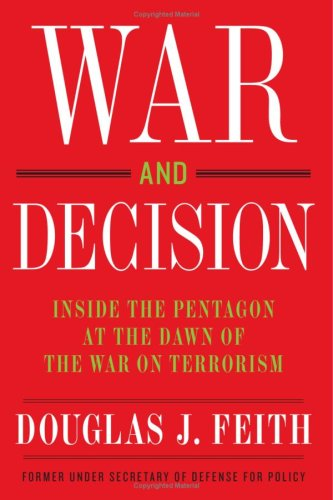
Douglas Feith was the U.S. Under Secretary of Defense for Policy from 2001 to 2005, one of the most senior positions at the Pentagon during one of the most consequential periods in recent history, covering the 11 September 2001 atrocities and early phase of the U.S.-led response. Feith later wrote a highly illuminating memoir, War and Decision: Inside the Pentagon at the Dawn of the War on Terrorism, which tried to drain some of the hysteria out of the public “debate” about the Iraq dimension of the U.S. policy in particular by explaining the internal arguments in the Bush administration leading up to the decision to finish with Saddam Husayn in 2003, and trying to set those arguments in their proper historical context, both in relation to Iraq—where “the war” had begun twelve years earlier—and the altered American threat perceptions in the shadow of 9/11. Unlike a lot of the gossipy tomes that emerged from former officials, Feith’s book is notably light on opinion and contains reams of declassified documents so readers can check his analysis against the source material. One of Feith’s key judgments is that “the chief mistake was maintaining an occupation government in Iraq for over a year”.[1] As Feith explains in great detail in the book, this was never supposed to happen. So how did it?

Continue reading

Islamic State Bids Farewell to the Caliph

By Kyle Orton (@KyleWOrton) on 10 November 2019

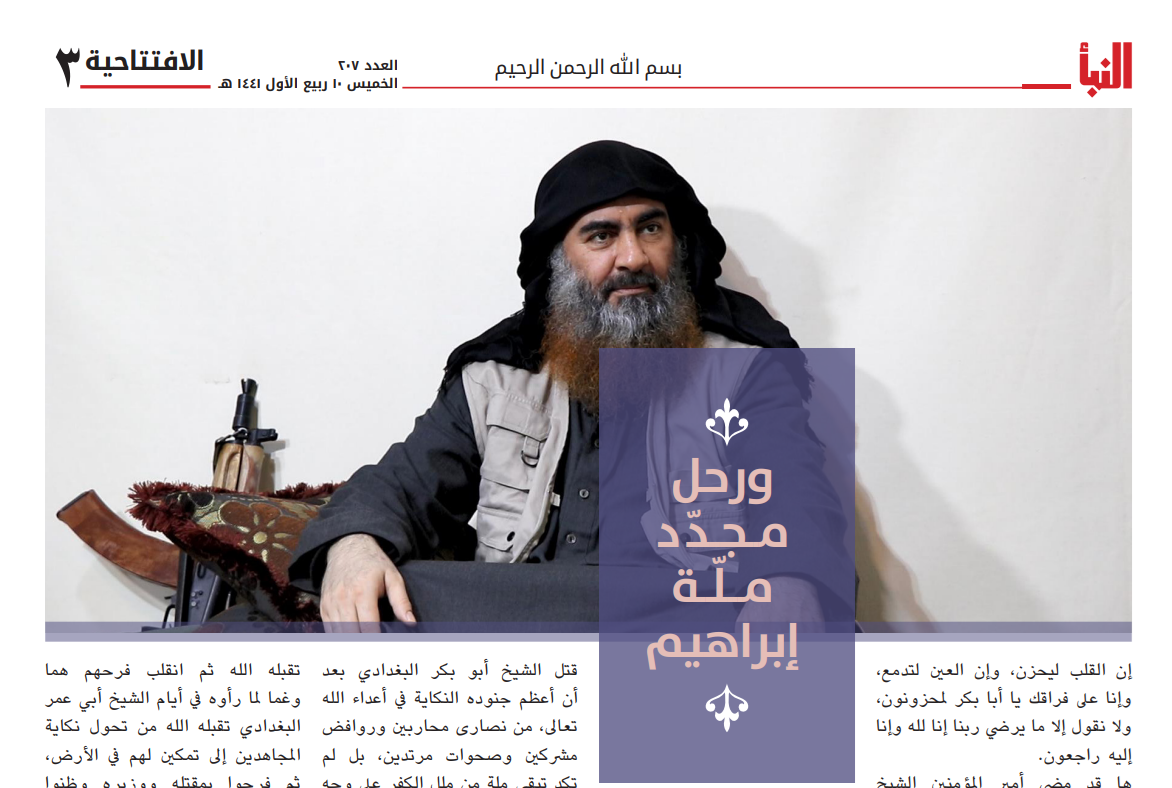
The 207th edition of Al-Naba, the weekly newsletter of the Islamic State (IS), published on 7 November 2019, devotes its main editorial to Ibrahim al-Badri (Abu Bakr al-Baghdadi), the first “Caliph” when the “Caliphate” was declared in June 2014, who was killed on 27 October 2019.

Continue reading

In Search of the Caliph

By Kyle Orton (@KyleWOrton) on 8 November 2019

This article was originally published at European Eye on Radicalization under the headline, “Who is the New Leader of the Islamic State?” 
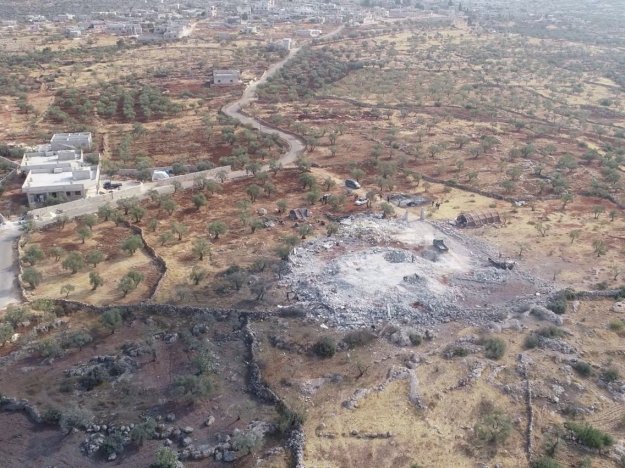
The destroyed compound where Abu Bakr al-Baghdadi was found in Syria // Drone footage taken by Turkey’s state-run Anadolu Agency

The so-called caliph of the Islamic State (ISIS), Ibrahim al-Badri (Abu Bakr al-Baghdadi), was killed in an American raid in Syria on 27 October, and the spokesman, Abu Hassan al-Muhajir, was killed the next day in an airstrike. ISIS acknowledged the losses and appointed new leaders on Halloween.

Abu Hamza al-Qurayshi introduced himself in a nearly-eight-minute audio statement as the new spokesman and named Abu Ibrahim al-Hashemi al-Qurayshi as Al-Baghdadi’s replacement. Little information was given about either man.

The U.S. government has said it knows “almost nothing” about the new caliph, Abu Ibrahim, leaving us no closer, for now, to knowing his identity. But some options present themselves. Continue reading

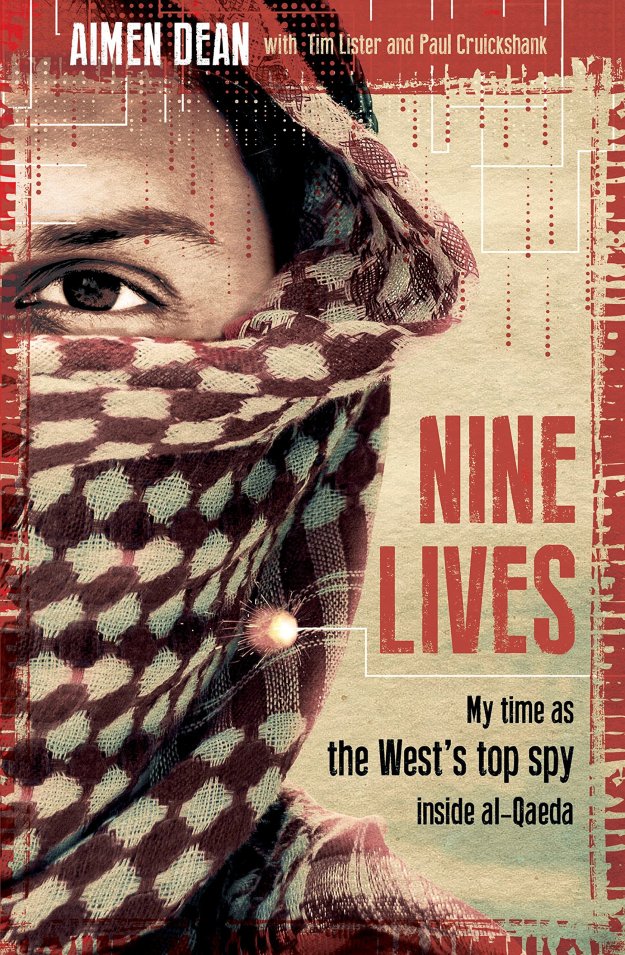
The Memoir of a British Spy in Al-Qaeda

By Kyle Orton (@KyleWOrton) on 8 July 2019

This article was originally published at the European Eye on Radicalization

The main issue that Nine Lives has to overcome is the one that has attended Aimen Dean (a pseudonym) since he went public in March 2015 with an interview he gave to the BBC, claiming he had been a British spy within Al-Qaeda between 1998 and 2006. That issue is overcoming the doubts about his story. Nine Lives goes a long way to solving this by bringing in Paul Cruickshank, the editor-in-chief of CTC Sentinel, one of the premier academic resources in the terrorism field, and Tim Lister, a terrorism-focused journalist with CNN, as co-authors. As well as helping structure the book from Dean’s memories, the two co-authors note they had been able to “corroborate key details” that convinced them: “In the years immediately leading up to and following 9/11, Aimen Dean was by far the most important spy the West had inside al-Qaeda”.

Continue reading

Islamic State Profiles the Leadership

By Kyle Orton (@KyleWOrton) on 6 April 2019

Islamic State flag in front of the main gate of Saddam Husayn’s palace in Tikrit, 5 April 2015 // AFP PHOTO / MOHAMMED SAWAF

A lengthy document—roughly sixty pages and 12,000 words—was published online on 21 February 2019 containing biographies of twenty-seven senior Islamic State (IS) officials, past and more recent. Those bios that are dated were written between October 2018 and the time of publication, with one exception that was written in the summer of 2018. The author claims to be an IS veteran. While longevity is difficult to prove, the fact that the author provides heretofore unseen images of some of the IS leaders suggests that at a minimum he is an IS operative. Continue reading

The Shah, the Cold War, and the Islamists

By Kyle Orton (@KyleWOrton) on 20 March 2019

Abbas Milani’s The Shah gives a portrait of Iran’s last monarch, Muhammad Reza Pahlavi, and the impact that his downfall forty years ago continues to have in the Middle East, notably the emboldening of the Islamist movement. Continue reading

The Fall of the Shah and the Rise of Islamism

By Kyle Orton (@KyleWOrton) on 17 January 2019

Forty years ago yesterday, Muhammad Reza Pahlavi, the Shah (King) of Iran, left his country for the last time as a year-long revolution crested. A month later, the remnants of the Imperial Government collapsed and Grand Ayatollah Ruhollah Khomeini was swept to power after his long exile, establishing the first Islamist regime. Andrew Scott Cooper’s 2016 book, The Fall of Heaven: The Pahlavis and the Final Days of Imperial Iran, charts how this happened. Continue reading

The Russian Relationship with Israel: A History

By Kyle Orton (@KyleWOrton) on 12 December 2018

© AP Photo / Jim Hollander, Pool

Essay: “Zionism is Making Us Stupid”: The Russian Relationship with Israel from the Soviets to Putin Continue reading

What Captured ISIS Jihadists Tell Us About the Group

By Kyle Orton (@KyleWOrton) on 2 December 2018

An Islamic State poster near al-Sukhna in the eastern Homs desert, Syria, August 2017 (source)

Over the past week, two members of the Islamic State (IS) have been arrested—a rarity in itself during the Coalition campaign against the group—and both in different ways give a glimpse of archetypes that have made up the organisation, from its inception to its expansion into Syria. Continue reading