Category Archives: Islamic Militancy

Demise of an ex-Saddamist in Libya

By Kyle Orton (@KyleWOrton) on July 21, 2015
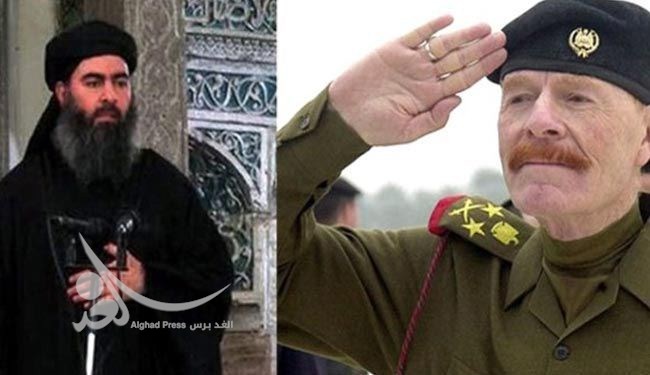
Abu Nabil al-Anbari

Abu Nabil al-Anbari

An Islamic State (ISIS) commander was killed in Libya in mid-June, The Daily Beast reported yesterday, after being “paraded … through the streets amid the taunts of onlookers, and then walked … to a gallows, where he was hanged.” [SEE UPDATES] This occurred in the eastern city of Derna, long a hotbed of Islamic militancy. The crucial thing about the “executed” ISIS operative is that he was an Iraqi and an FRE—a former (Saddam) regime element—who had been dispatched to Libya last year to oversee the cultivation of an ISIS branch.
Continue reading

Saddam’s Henchmen Were Fanatics Long Before They Joined The Islamic State

By Kyle Orton (@KyleWOrton) on July 20, 2015

Published at National Review

After long neglect, the media has finally recognized the role of the FREs—former (Saddam) regime elements—within the Islamic State (ISIS). But the pendulum has now swung too far: Some reports are now claiming that the FREs have transformed the leader of the terror army, Abu Bakr al-Baghdadi, into nothing more than a front man for the Baathists.

These suppositions are mistaken. Most FREs within ISIS have not been ideologically Baathists for a long time. Continue reading

Is Ahrar a-Sham a “Moderate” Syrian Rebel Group?

By Kyle Orton (@KyleWOrton) on July 12, 2015

Ahrar a-Sham

To answer my headline simply: no, Ahrar a-Sham’s leadership is not what anybody in the West means by “moderate” Syrian rebels that could be supported.

The question is provoked by an op-ed in The Washington Post last night signed by Labib al-Nahhas, Ahrar’s foreign political relations officer, the culmination of a public-relations campaign by Ahrar to rebrand itself as the mainstream alternative to the Islamic State (ISIS) and the Assad tyranny we’ve all been waiting for. Continue reading

Islamic State: The Afterlife of Saddam Hussein’s Regime

By Kyle Orton (@KyleWOrton) on July 4, 2015

Published at Baghdad Invest

1

Izzat Ibrahim ad-Douri, Saddam Hussein’s long-time deputy, was reported dead (again) on April 17. An audio message on May 15 disproved this. Douri was the implementer of the Saddam regime’s Islamization program in its later years and a key architect of the insurgency after the regime was overthrown, which helped pave the way for the Islamic State (ISIS). ISIS has now turned on Douri and his associates, but ISIS could not have risen to its current stature without Douri’s help. Continue reading

To Defeat The Islamic State, Get Rid Of Assad First

By Kyle Orton (@KyleWOrton) on July 3, 2015

1

The British government is considering beginning airstrikes into Syria against the Islamic State (ISIS). London is currently engaged in airstrikes against ISIS in Iraq and has troops in the Kurdish areas of northern Iraq training and advising the Peshmerga.

Since ISIS’ territory in Syria is its “most valuable and sustainable,” the case for ignoring a border that ISIS has erased would seem to be a good one.

But no less a figure than the Conservative chair of the defence select committee, Julian Lewis, thinks otherwise:

In 2010 the government wanted to remove Assad without helping al-Qaeda or similar groups that subsequently became Daesh. Now we apparently want to remove Daesh but without helping Assad. These two things are incompatible. It is a choice of evils.

The view that Syria is divided between the Assad dictatorship and ISIS has become commonplace. It is mistaken. Continue reading

A Postscript on the Relationship Between Saddam Hussein and Al-Qaeda

By Kyle Orton (@KyleWOrton) on June 26, 2015

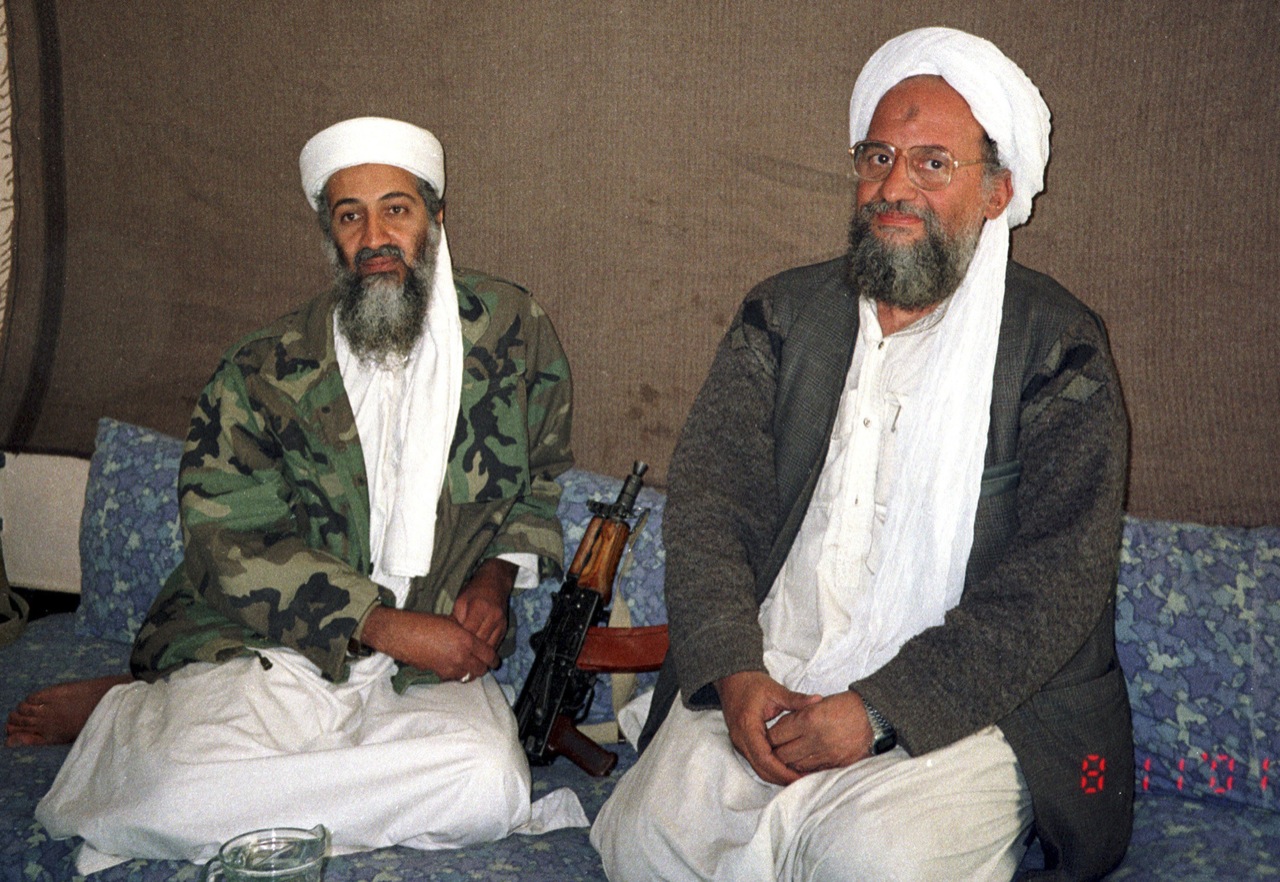
Osama bin Laden (L) and Ayman az-Zawahiri (R)

Osama bin Laden (L) and Ayman az-Zawahiri (R)

The myth that Saddam Hussein’s regime had nothing to do with al-Qaeda is persistent. Stephen Hayes’ book, The Connection, ably debunks this notion. There are some additional details that one can add to this. Continue reading

Does Iran Support The Islamic State?

By Kyle Orton (@KyleWOrton) on May 26, 2015

Qassem Suleimani, Iran's spymaster, believed in some MidEast conspiracy theories to control ISIS

Qassem Suleimani, Iran’s spymaster, believed in some Mid-East conspiracy theories to control ISIS

In 2010, Farzad Farhangian, an Iranian diplomat based in Belgium, defected to Norway. Farhangian has now emerged with the extraordinary accusation that the Islamic Republic of Iran is controlling the Islamic State (ISIS) and using it as part of Tehran’s war against the Gulf States, especially Saudi Arabia. Farhangian’s accusations are lurid and (literally) incredible, but the question of Iran’s role in ISIS’ creation and growth, and Iran’s manipulation of ISIS to further its own ends, is one well worth asking. Continue reading

The Islamic State’s Strategy Is Working, Its Enemies Are Failing

By Kyle Orton (@KyleWOrton) on May 23, 2015

1

To hear President Obama tell it, his announced program to defeat the Islamic State (ISIS), which began with airstrikes into Iraq last August that were extended into Syria in September, is working, albeit with some tactical setbacks. The implication is that the setbacks of the U.S.-led anti-ISIS campaign are not strategic.

As J.M. Berger phrased it:

In the Washington vernacular, the act of Being Strategic implies a near mystical quality of superior thinking possessed by some, and clearly lacking amongst the vulgarians of the world—heedless brutes such as ISIL. Tactics are short-term ploys, easy to dismiss. Strategy is for winners.

Unfortunately, this soothing view is almost exactly wrong: it is the United States that is relying on various short-term methods—commando raids into the Syrian desert, for example—while ISIS has a long-term goal fixed in mind and is working assiduously to achieve it. The U.S.-led Coalition is losing, in short, and ISIS is winning. Continue reading

Raids in Syria Can’t Defeat the Islamic State If Obama Continues Alignment with Iran

By Kyle Orton (@KyleWOrton) on May 16, 2015

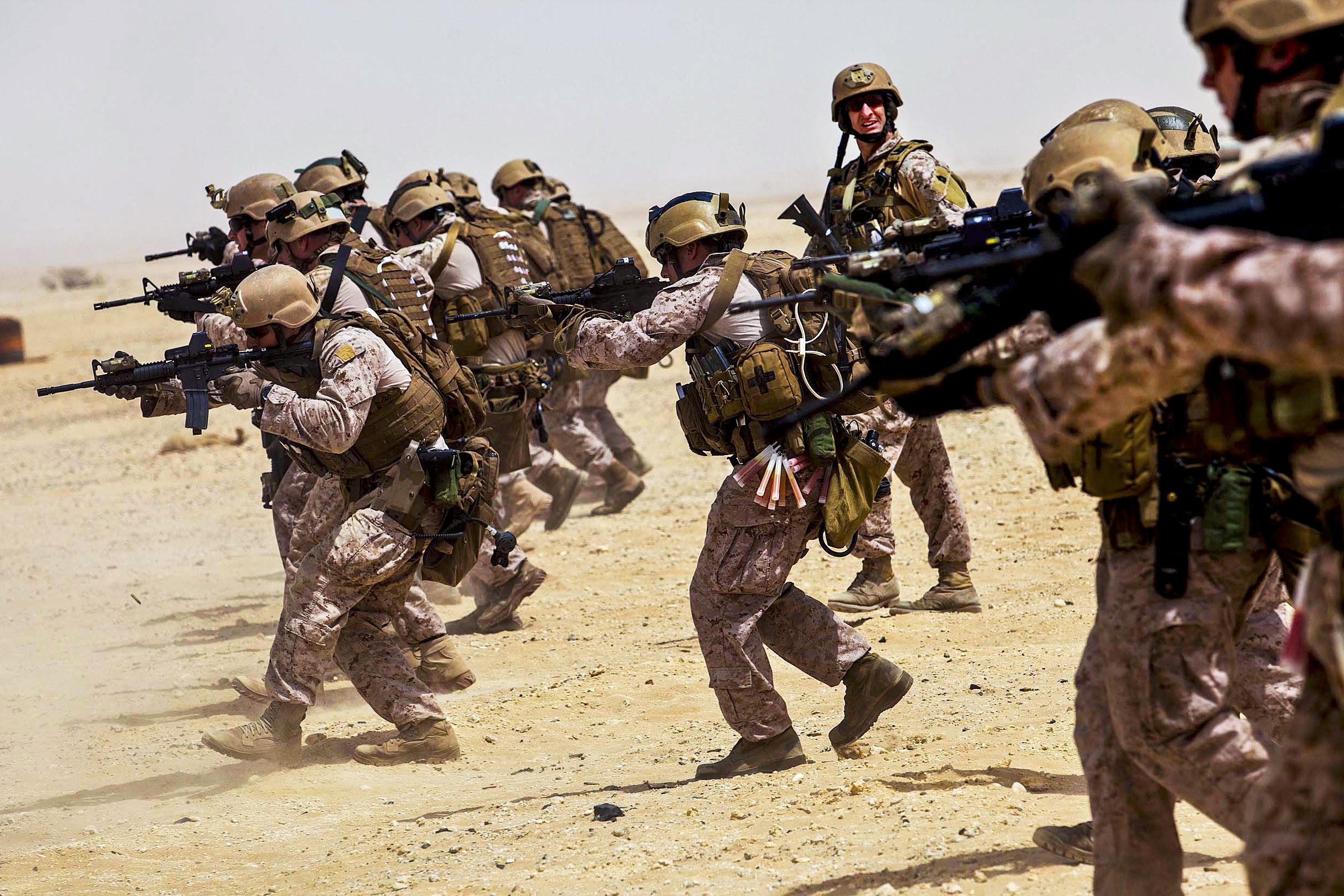
26th Marine Expeditionary Unit (MEU) Maritime Raid Force Marines fire M4 Carbines while conducting a marksmanship training exercise at a range in Qatar, April 22, 2013. Eagle Resolve is an annual multilateral exercise designed to enhance regional cooperative defense efforts of the Gulf Cooperation Council nations and U.S. Central Command. The 26th MEU is deployed to the 5th Fleet area of operations aboard the Kearsarge Amphibious Ready Group. The 26th MEU operates continuously across the globe, providing the president and unified combatant commanders with a forward-deployed, sea-based quick reaction force. The MEU is a Marine Air-Ground Task Force capable of conducting amphibious operations, crisis response and limited contingency operations. (U.S. Marine Corps photo by Cpl. Christopher Q. Stone, 26th MEU Combat Camera/Released)

Last night the United States launched a commando raid into al-Amr in Deir Ezzor in eastern Syria. According to the White House statement, Abu Sayyaf (real name: Fathi ben Awn ben Jildi Murad al-Tunisi), a senior Islamic State (ISIS) commander “overseeing … illicit oil and gas operations,” was killed, and his wife, Umm Sayyaf, was taken into American custody and is being held in Iraq. The Sayyaf couple had been holding a young Yazidi woman as a slave and she has now been freed.

Unfortunately, this American raid is a tactical success amid a strategic failure—and a tactical success likely to be used to obscure the strategic failure of the U.S. anti-ISIS campaign. Even in the narrowest humanitarian terms: if the freedom of this one Yazidi girl is used to perpetuate a policy that leaves many more Yazidi girls in bondage then it is a failure. Continue reading

Book Review: The Muslim Discovery of Europe (1982) by Bernard Lewis

By Kyle Orton (@KyleWOrton) on May 7, 2015

1

With the triumph of relativism and the current economic woes of the West, the sense that Western civilization is unique and in some respects—to use an old-fashioned word—better than the alternatives, and worth defending and exporting, is waning. But Bernard Lewis’ The Muslim Discovery of Europe suggests a longer view in which Europe, while containing all the faults of previous civilizations, has been one of the few to begin the process of correcting those faults, and has corrected many more than any other civilization.

One feature of European civilization that stands out as unique is curiosity. Continue reading