By Kyle Orton (@KyleWOrton) on 9 October 2019

Interview with De Re Militari Journal. Continue reading
By Kyle Orton (@KyleWOrton) on 9 October 2019

Interview with De Re Militari Journal. Continue reading
This article was published at The New Turkey
By Kyle Orton (@KyleWOrton) on 1 October 2019

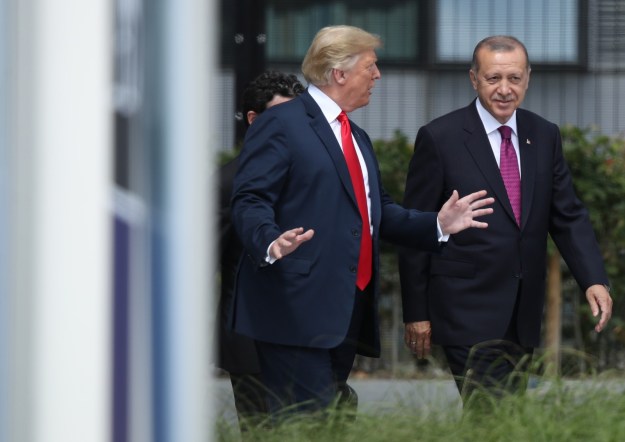
U.S. President Donald Trump and Turkish President Recep Tayyip Erdogan at the opening ceremony of the NATO Summit in Brussels, July 2018 // Getty Images
Turkey’s President Recep Tayyip Erdogan had said earlier in September that he would discuss the problems between Turkey and the United States when he met with the U.S. President Donald Trump on September 25, as part of his trip to New York for the opening of the United Nations General Assembly. But neither side has revealed what was discussed and if anything was resolved. Continue reading
By Kyle Orton (@KyleWOrton) on 12 September 2019

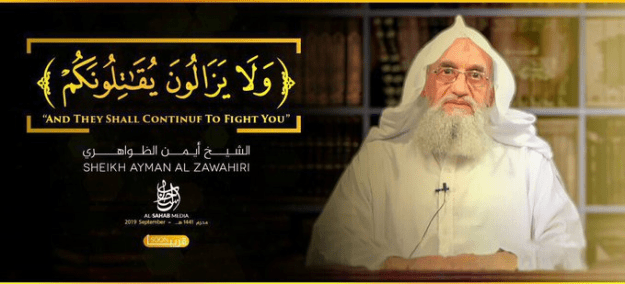
To mark the eighteenth anniversary of the 9/11 massacre, Al-Qaeda’s Al-Sahab media department released a video, “And They Shall Continue to Fight You”. The video, which ran over a half-hour, featured a speech by the group’s emir, Ayman al-Zawahiri, interspersed with other leadership figures.
Much attention has been given to Dr. Al-Zawahiri encouraging attacks on America, his contention that the U.S. has enabled the spread of Iranian power by providing its vicious sectarian militias in Iraq, Syria, and beyond with direct support as part of the war against the Islamic State (ISIS), and his use of the issue of Palestine. There are some indications Al-Qaeda is looking abroad again with its terrorism campaign, but the primary purpose of re-emphasising the justice of attacks on the West seems to be to meet the ideological challenge from ISIS. Behind the veneer of the “far enemy” rhetoric in this speech, Al-Zawahiri was in fact very defensive—particularly about 9/11, Al-Qaeda’s greatest “success”, where he seems stung by the accusation Al-Qaeda murdered innocents—and “near enemy” (regionally) focused. Even the call to attack America suggested attacks on military installations in the Middle East, rather than in America itself. Such attacks would also avoid the issue of civilian casualties, Al-Zawahiri noted.
An English translation was put out of the video of Al-Zawahiri’s speech and a transcript is reproduced below.
Continue reading
By Kyle Orton (@KyleWOrton) on 25 August 2019
A version of this article was published at The Arab Weekly

Devastation in Khan Shaykhun, Idlib, Syria, 3 August 2019 (AFP)
Bashar al-Assad’s regime, supported by Russia and (in a more deniable form) Iran, began an offensive against the last insurgent-held enclave in Syria, Idlib, in the last days of April. Up until a month ago, this looked like an embarrassing fiasco: with a minimal increase in Turkish support to its rebel proxies, the pro-Assad forces had been able to gain about one-percent of the territory in the southern part of “Greater Idlib”. In the last fortnight, however, the pro-Assad coalition has made important breakthroughs that could prove decisive. Continue reading
By Kyle Orton (@KyleWOrton) and Rob Clark (@RobertClark87) on 26 July 2019

A speedboat and a helicopter of the Iran’s Islamic Revolutionary Guards Corps Navy move around a British-flagged oil tanker Stena Impero, 21 July 2019. (Hasan Shirvani/Mizan News Agency via AP)
The series of provocations in the Gulf by the Islamic Republic of Iran, beginning with the sabotage of four vessels in mid-May, culminated last Friday in the illegal seizure by the Iranian Revolutionary Guard Corps Navy (IRGCN) of the British-flagged and operated Stena Impero oil tanker, followed shortly thereafter by the seizure of the Liberian-flagged, British operated MV Mesdar in the Strait of Hormuz. Only the Mesdar has been released. This episode has served to demonstrate the serious defence issues confronting Boris Johnson, the incoming United Kingdom (UK) Prime Minister, which have to be dealt with immediately and cannot be pushed off into the future when the domestic turbulence over Brexit has abated. Continue reading
By Kyle Orton (@KyleWOrton) on 22 July 2019

U.S. President Donald Trump and Turkey’s President Recep Tayyip Erdogan meeting during the G20 leaders summit in Osaka, Japan, 29 June 2019 [image source]
By Kyle Orton (@KyleWOrton) on 20 July 2019

Sketch of Ruslan Asainov // Image credit: Jane Rosenberg/Reuters
In the Eastern District of New York, on 19 July, a criminal complaint was unsealed against Ruslan Maratovich Asainov, described in the press release as a “naturalized U.S. citizen born in Kazakhstan”. According to the release, Asainov is to be charged with providing and attempting to provide “material support, including training, services, and personnel” to a terrorist group, namely the Islamic State (IS), which he joined in 2013 and rose through the ranks to become an emir. Asainov was captured by the “Syrian Democratic Forces” (SDF), the Coalition’s anti-IS Kurdish partner force, and handed over to the FBI, before being returned to America this month. The maximum penalty for these charges is twenty years imprisonment, and it is likely the U.S. government will be seeking additional charges in the indictment. The case raises an interesting question over the gaps in knowledge about IS. Continue reading
By Kyle Orton (@KyleWOrton) and Oved Lobel on 14 July 2019

Abror Azimov in court in Moscow in April 2017 [photo source] and Mukhamadyusup Ermatov [photo source]
By Kyle Orton (@KyleWOrton) on 9 July 2019

Al-Qaeda’s leader, Ayman al-Zawahiri, released a speech, “Don’t Forget Kashmir”, which as the title suggests focused on that conflict on the Subcontinent. Al-Zawahiri was insistent on fighting India, but he also wanted to “liberate” the Kashmiri jihad from the oversight of the Pakistani secret police and military, who have used these Islamist paramilitary forces as instruments of state policy against the Indian Union since the time of partition. In Al-Zawahiri’s telling the Pakistani state, such as it is, is too close to the Americans and the West. A transcript of the speech, released in English by Al-Qaeda’s As-Sahab Media, is reproduced below. Continue reading
By Kyle Orton (@KyleWOrton) on 8 July 2019
This article was originally published at the European Eye on Radicalization

The main issue that Nine Lives has to overcome is the one that has attended Aimen Dean (a pseudonym) since he went public in March 2015 with an interview he gave to the BBC, claiming he had been a British spy within Al-Qaeda between 1998 and 2006. That issue is overcoming the doubts about his story. Nine Lives goes a long way to solving this by bringing in Paul Cruickshank, the editor-in-chief of CTC Sentinel, one of the premier academic resources in the terrorism field, and Tim Lister, a terrorism-focused journalist with CNN, as co-authors. As well as helping structure the book from Dean’s memories, the two co-authors note they had been able to “corroborate key details” that convinced them: “In the years immediately leading up to and following 9/11, Aimen Dean was by far the most important spy the West had inside al-Qaeda”.
Continue reading