Tag Archives: caliphate

The Islamic State Explains Why It Hates The West

By Kyle Orton (@KyleWOrton) on August 1, 2016

dabiq-15-3

The Islamic State (IS) published its fifteenth edition of ‘Dabiq,’ its English-language magazine, on 31 July 2016. The magazine was entitled, “Break the Cross”. The magazine contained two important articles outlining why IS hates and fights against the West. The most important article, an unsigned piece by an IS operative, simply titled, “Why We Hate You and Why We Fight You”. The second, “How I Came to Islam,” was written by Umm Khalid al-Finlandiyyah, a female Finnish foreign fighter who has joined IS. Those articles are reproduced below with some editions to transliteration and some interesting sections highlighted in bold. Continue reading

The Islamic State’s Newsletter Prepares for the End of the Caliphate

By Kyle Orton (@KyleWOrton) on June 9, 2016

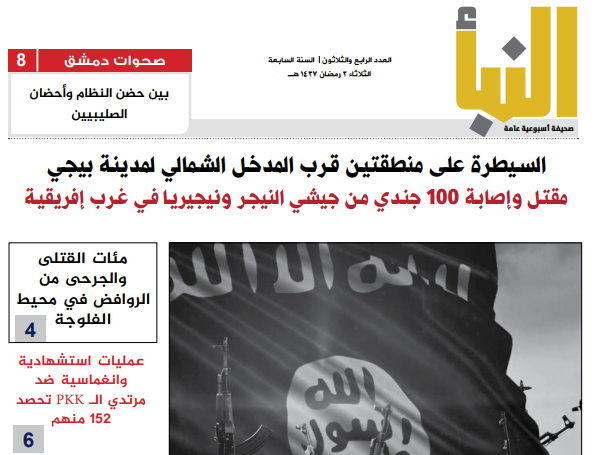
First page of the 34th edition of the Islamic State newsletter, al-Naba

The Islamic State’s (IS) spokesman, Taha Falaha (Abu Muhammad al-Adnani), gave a speech on 21 May that prepared the ground ideologically for the end of IS’s statelet and a return to the deserts where the organization survived after the surge-and-sahwa drove it from the urban zones of Iraq in 2007-08. Al-Naba, IS’s newsletter, is printed within the caliphate on Saturdays and distributed online on Tuesdays. Al-Naba’s 34th edition, published within the territories on 4 June and put on the internet on 7 June, echoed Falaha’s theme that the caliphate was a cause that would outlast the loss of territory since it was now embedded in the hearts of a generation of Muslims, and al-Naba also took a swipe at al-Qaeda and jihadi groups like Ahrar al-Sham that believe the path to an Islamist polity is bottom-up, through the building of popular consent. The Naba editorial is reproduced below with some important sections highlighted in bold.
Continue reading

Islam’s First Terrorists, Part 3

By Kyle Orton (@KyleWOrton) on August 19, 2015

This is the third of a six-part series. Read parts one and two.
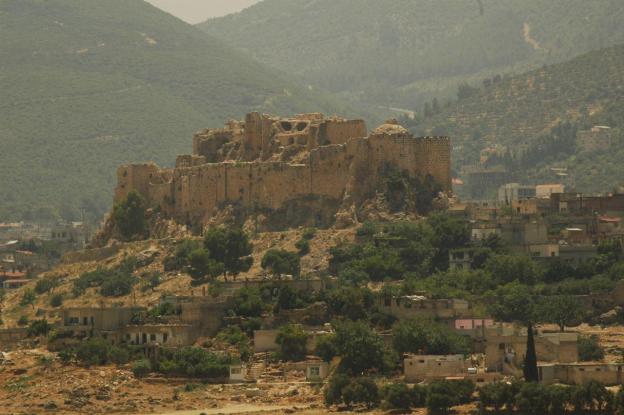
Masyaf fortress, eastern Hama, the headquarters of the Assassins (1141-1270)

Masyaf fortress, eastern Hama, the headquarters of the Assassins (1141-1270)

The death of Hassan-i Sabbah and The Resurrection

Rashid ad-Din Sinan

Rashid ad-Din Sinan

Hassan-i Sabbah, the Nizaris’ first and most successful leader, died in May 1124. Hassan-i Sabbah was a fanatic who sternly imposed the Holy Law—even executing one of his own sons for drinking wine and another son (mistakenly) for an unauthorized assassination. An extreme ascetic and recluse, Hassan-i Sabbah left his house twice in the thirty-five years after taking Alamut. Hassan-i Sabbah’s great skill was in weaponizing the discontents of the dispossessed and refining the doctrine of al-dawa jadida (the new preaching).

Hassan-i Sabbah never claimed to be the Imam, merely the only one who knew what the Imam wanted. Hassan-i Sabbah confirmed the Ismaili doctrine as essentially authoritarian, where the believer must follow an Imam, the only source of truth, who has been appointed by god (unlike the Sunni view where the believer can choose an Imam).

The Nizaris’ history divides into essentially four parts after this: Continue reading

Islam’s First Terrorists, Part 1

By Kyle Orton (@KyleWOrton) on August 17, 20151

Book Review: The Assassins: A Radical Sect in Islam (1967) by Bernard Lewis

Abstract

The fourth Caliph, Ali, was assassinated during a civil war that his supporters, Shi’atu Ali (Followers of Ali), lost to the Umayyads, who thereafter moved the capital to Damascus. The Shi’a maintained that the Caliphate should have been kept in the Prophet’s family; over time this faction evolved into a sect unto themselves, which largely functioned as an official opposition, maintaining its claim to the Caliphate, but doing little about it. Several ghulat (extremist) Shi’a movements emerged that did challenge the Caliphate. One of them was the Ismailis. Calling themselves the Fatimids, the Ismailis managed to set up a rival Caliphate in Cairo from the mid-tenth century until the early twelfth century that covered most of North Africa and western Syria. A radical splinter of the Ismailis, the Nizaris, broke with the Fatimids in the late eleventh century and for the next century-and-a-half waged a campaign of terror against the Sunni order from bases in Persia and then Syria. In the late thirteenth century the Nizaris were overwhelmed by the Mongols in Persia and by the Egyptian Mameluke dynasty which halted the Mongol invasion in Syria. The Syrian-based branch of the Nizaris became known as the Assassins, and attained legendary status in the West after they murdered several Crusader officials in the Levant. Attention has often turned back to the Assassins in the West when terrorist groups from the Middle East are in the news, but in the contemporary case of the Islamic State (ISIS) the lessons the Nizaris can provide are limited. Continue reading

Islamic State Spokesman Calls For Immigration to the Caliphate, All Factions To Join

By Kyle Orton (@KyleWOrton) on July 1, 2015

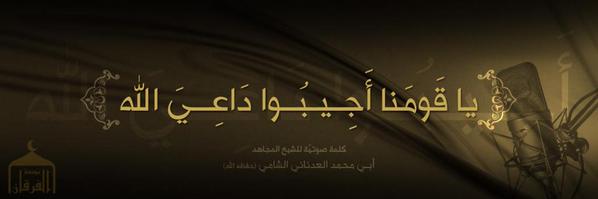
On June 23, 2015, the Islamic State (IS) spokesman Abu Muhammad al-Adnani gave a speech, “O Our People, Respond to the Caller of Allah”. Al-Adnani, noting the coming of Ramadan, called on Muslims to journey to the caliphate, saying that hijra (emigration) in this month—and martyrdom—is the most blessed. Al-Adnani called on Muslims—specifically Iraqi Sunnis and Syrian rebel and Islamist insurgent groups—to unite around IS, which had no theological factions or ethnic distinctions among its membership, being the only pure expression of Islam, ruling by god’s law. Iraqi Sunni militias and Syrian rebels had betrayed the religion by seeking favour from, and even seeking alliance with, Western states. Al-Adnani threatened the town of Haditha, specifically the Jaghayfa clan, that if it surrendered now its repentance would be accepted, but if the town was overrun first then they would be slaughtered. Al-Adnani played heavily on the interlinked themes of anti-Shi’a sectarianism and the spreading influence of Iran and its proxies, repressing Sunnis. The old guard of the jihadi movement—clerics like Abu Muhammad al-Maqdisi and al-Qaeda’s leader Ayman al-Zawahiri (though neither are mentioned by name)—are attacked for not being on the battlefields. Al-Adnani also accepted the allegiance of the Russian-based faction that declared itself under the caliph’s authority, naming the group Wilayat al-Kavkaz. An English transcript of the speech was posted by IS and is reproduced below with some minor editions in transliteration and some interesting sections highlighted in bold. Continue reading

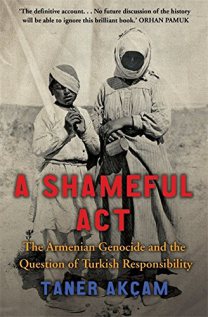
Book Review: A Shameful Act (2006) by Taner Akcam

By Kyle Orton (@KyleWOrton) on June 9, 20151

This is the complete review. It has previously been posted in three parts: Part 1 on the question of whether the 1915-17 massacres constitute genocide; Part 2 on the post-war trials and the Nationalist Movement; and Part 3 gives some conclusions on what went wrong in the Allied efforts to prosecute the war criminals and the implications for the present time, with Turkey’s ongoing denial of the genocide and the exodus of Christians from the Middle East.

A Question of Genocide

The controversy over the 1915-17 massacres of Armenian Christians by the Ottoman Empire is whether these acts constitute genocide. Those who say they don’t are not the equivalent of Holocaust-deniers in that while some minimize the figures of the slain, they do not deny that the massacres happened; what they deny is that the massacres reach the legal definition of genocide. Their case is based on three interlinked arguments:

  • Unlike the Nazi Holocaust when a defenceless population was murdered only for its identity, the Armenians were engaged in a massive armed revolt, and this is why the Ottoman government decided to deport them.
  • The intent of the Ottomans was not massacre but the removal of the Armenians, who had sided with one foreign invading power (Russia) and who were showing signs of collaborating with another (Britain), from the militarily sensitive areas as Turkey suffered a two-front invasion in early 1915.
  • While terrible massacres, plus starvation and the cold, took maybe a million lives during the deportations, when the Armenians reached their destinations in Syria and Iraq, which were also part of the Ottoman Empire, they were well-treated and allowed to rebuild their lives, which would not have been the case had the Ottomans intended their destruction.

Taner Akcam’s A Shameful Act: The Armenian Genocide and the Question of Turkish Responsibility presents evidence to undermine every one of these arguments. Continue reading

Book Review: A Shameful Act (2006) by Taner Akcam, Part 3

By Kyle Orton (@KyleWOrton) on June 7, 20151

Post-War Turkey

The last foreign troops left Istanbul on October 2, 1923. On October 6, Turkish troops re-occupied Istanbul, and on October 13 the Turkish capital was moved to Ankara. The independence struggle won, the focus now turned to the form independence would take.

Having already abolished the Sultanate—that is the executive post held by the House of Ottoman—Mustafa Kemal (later Atatürk) abolished the Caliphate on March 3, 1924. Atatürk also scrapped the office of Şeyh-ül İslam, banished the House of Ottoman (packing Sultan Abdülmecid onto the Orient Express), and closed the separate religious schools on the same day. The ulema had given much ground during the reforms of the nineteenth century but they had also frustrated and defeated many reformers; Atatürk would not be one of them. The promulgation of the Republican Constitution on April 20, 1924, confirmed parliamentary supremacy over the shari’a, secular law over theocracy.

In the late 1920s, further reforms were made. The fez, which “had become the last symbol of Muslim identification,” was banned. Atatürk had said the fez was “an emblem of ignorance … and hatred of progress”. Turks would wear the costume “common to the civilized nations of the world,” which is to say Europe. Atatürk adopted the Swiss legal code, which removed the Holy Law from personal status—abolishing polygamy, making both parties to a marriage equal, allowing divorce, and allowing people to change their religion. Islam was disestablished as the State religion, and as the final step the Arabic script was changed to Roman. The connection with the East was broken, and Turkey was firmly oriented West. Continue reading

Islamic State Leader Attacks Saudi Arabia, Claims to Be the Sunni Vanguard

By Kyle Orton (@KyleWOrton) on May 15, 2015

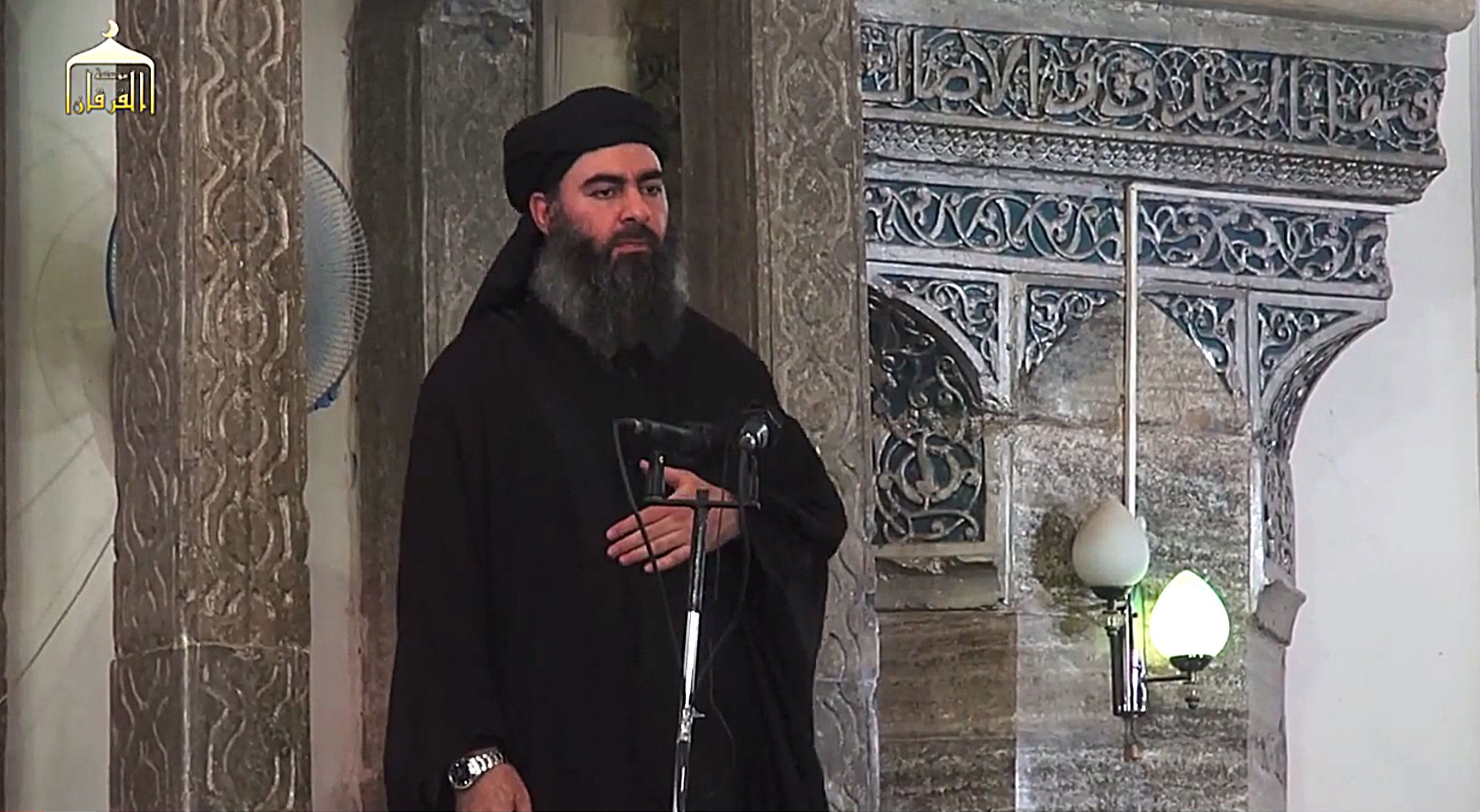
The Islamic State’s “caliph”, Ibrahim al-Badri (Abu Bakr al-Baghdadi), gave his ninth speech on May 14, 2015. The speech was entitled, “March Forth Whether Light or Heavy”, based on the 41st verse of the ninth sura of the Qur’an, Al-Tawba. A transcript of this speech was released and is reproduced below. Continue reading

The Islamic State, Libya, and Interventionism

By Kyle Orton (@KyleWOrton) on February 19, 2015

Rebels with Qaddafi's

Rebels with Qaddafi’s “golden gun”

Yesterday morning in Libya, it was announced that militias from Misrata were moving into Sirte to combat the Islamic State (I.S.). The militias preparing to fight I.S. are drawn from Libya Dawn, the Islamist coalition that ousted the internationally-recognised government in August 2014. Continue reading

Al-Qaeda Issues Strategic Guidelines for Jihadist Warfare

By Kyle Orton (@KyleWOrton) on January 7, 2015

Al-Qaeda’s emir, Ayman al-Zawahiri, released a document on 14 September 2013, entitled, Tawjihat ‘Amma lil-Amal al-Jihadi (توجيهات عامة للعمل الجهادي), variously translated as: “General Guidelines for the Work of Jihad” or “General Guidelines for Jihadist Action”. Al-Zawahiri’s document is reproduced below. Continue reading