Tag Archives: France

Islamic State Operative Connected to Charlie Hebdo Attack Might Still Be Alive

By Kyle Orton (@KyleWOrton) on 15 April 2017

Boubaker al-Hakim (Abu Muqatil al-Tunisi) in Dabiq

Earlier today, an Iraqi military statement made public that the Iraqi government had provided coordinates to Bashar al-Assad’s air force, via the intelligence-sharing cell set up in Baghdad with Russia and Iran, for targets in Raqqa and al-Bukamal. One of the targets was Boubaker al-Hakim (Abu Muqatil al-Tunisi), a French-Tunisian Islamic State (IS) operative. Whether the Syrian regime’s strikes against al-Hakim were successful was not made clear. The interest here is that the U.S. announced on 10 December 2016 that it had killed al-Hakim in an airstrike near Raqqa on 26 November 2016, meaning that either the U.S. was mistaken or the Iraqis are. Al-Hakim is a very interesting figure in his own right with an extensive history in the jihadist movement and also highlights some broader trends, notably the assistance the Assad regime has provided to the IS movement. Continue reading

Islamic State Expands its Foreign Attacks Capacity As the Caliphate Collapses

Published at The International Business Times

By Kyle Orton (@KyleWOrton) on 23 March 2017

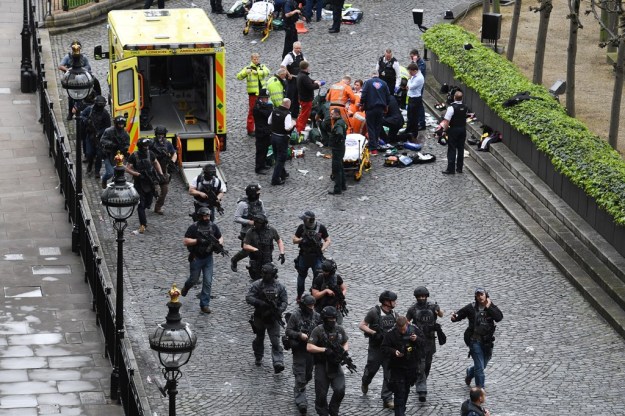
Aftermath of the Islamic State terrorist attack in Westminster, March 2017 (image source)

Just after 2:30pm yesterday afternoon, a terrorist mowed down pedestrians with a car on Westminster Bridge before jumping out near Parliament and stabbing a police officer to death. Three people were murdered, forty were injured, and the attacker was shot dead. The Islamic State (ISIS) has now claimed the attack.

The most important question is whether the terrorist had co-conspirators. Prime Minister Theresa May told Parliament this morning that it is “believed that this attacker acted alone”. It is crucial that this is not misread as saying that the attacker was a ‘lone wolf’. The arrests in Birmingham overnight suggest that this killer could have been part of a broader network, which would be consistent with the pattern of ISIS behaviour.

In a new report for the Henry Jackson Society, documents 152 foreign ISIS attacks in 34 countries since 2002, the vast majority in the past two years. In nearly three-quarters of the cases the attacks have a direct link to the organisation, and those without often have accomplices who assist in the atrocities in some way. Just 15% of the attacks have been by inspired individuals, who had no demonstrated connection to ISIS or anyone else in planning or executing their attack. Continue reading

The Assad Regime Admits to Manipulating the Islamic State

By Kyle Orton (@KyleWOrton) on January 6, 2017

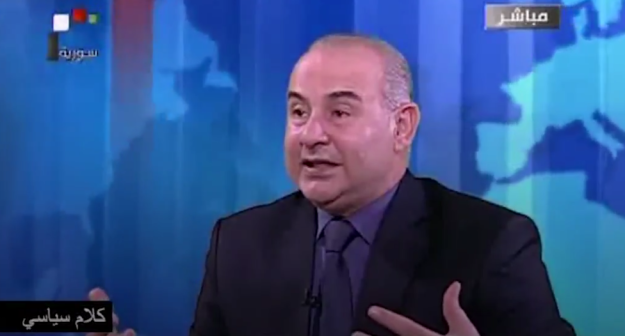
Khaled Abboud

From the beginning of the uprising in Syria in 2011, there have been accusations that Bashar al-Assad’s regime was in a de facto partnership with the Islamic State (IS) against the mainstream opposition. These accusations have a considerable basis in fact: during the entirety of the Anglo-American occupation of Iraq, Assad collaborated with IS jihadists in the destabilization of Iraq, killing thousands of Iraqi civilians and hundreds of American and British troops. Once the Syrian uprising was underway, the regime undertook various measures to bolster extremists in the insurgency. Assad and IS worked in tandem to leave Syria as a binary choice between themselves: Assad was sure this would rehabilitate him in the eyes of the world and transform his criminal regime into a partner of the international community in suppressing a terrorist insurgency, and IS wanted to rally Sunnis to its banner. The Secretary of the Syrian Parliament has now come forward to underline this. Continue reading

The Islamic State Guided the Normandy Church Attack

By Kyle Orton (@KyleWOrton) on August 22, 2016

Normandy church killers, Adel Kermiche and Abdelmalik Petitjean, swear allegiance to the Islamic State [video, 27 July 2016]

Normandy church killers, Adel Kermiche and Abdelmalik Petitjean, swear allegiance to the Islamic State [video, 27 July 2016]

In Saint-Etienne-du-Rouvray, south of Rouen in Normandy, northern France, on 26 June 2016, two men wielding knives took five hostages in a church around 10:00 local time (just a bit before).[1] Initially there were six hostages consisting of a priest, three nuns, and two worshippers, but one nun managed to escape and alerted the authorities, who surrounded the church.[2] The attackers murdered the priest, Jacques Hamel, 85 (born 30 November 1930[3]), making him kneel on the alter and slitting his throat while preaching in Arabic.[4] One of the nuns present said that while the two killers were initially nervous and aggressive, by the time of the murder they seemed content: one of them gave “a soft smile, that of someone who is happy”.[5] An elderly male worshipper was handed a mobile telephone and made to film the attackers slaughtering the priest, and was himself then slashed and grievously wounded.[6] That footage has not been released, but almost certainly will be at some point. “The two men had cried Allahu Akbar (God is Great) as they left the church with three of the hostages. One man had a fake suicide belt made of aluminium and three knives; the other was carrying a backpack made to look like a bomb and a kitchen timer.” The two attackers were shot dead by police.[7] Continue reading

Ahrar al-Sham and Al-Qaeda

By Kyle Orton (@KyleWOrton) on August 12, 2016

The Islamic State’s (IS) weekly newsletter, al-Naba, interviewed a high-ranking al-Qaeda defector, Abu Ubayda al-Lubnani, across two issues in February and March 2016. Abu Ubayda announced his defection from al-Qaeda to IS in April 2014 via al-Battar and Abu Ubayda’s name appeared on a list of prominent clerics supporting IS’s caliphate declaration that was circulated not long after the declaration. Abu Ubayda is described by al-Naba—as best as can be told accurately—as having been a member of al-Qaeda’s Shura or Consultation Council, a training officer in its Military Committee, and a counter-intelligence officer. Abu Ubayda is advertised as speaking about many secret aspects of al-Qaeda.

Among the topics Abu Ubayda covers is the alleged infiltration and manipulation of al-Qaeda by foreign intelligence services, specifically Pakistan’s Inter-Services Intelligence (ISI), which is not only a violation of jihadist doctrine by collaborating with an “infidel” and illegitimate state but led to the deaths of a number of senior al-Qaeda leaders.

Perhaps the most intriguing aspect of what Abu Ubayda has to say relates to al-Qaeda’s attempt to take advantage of the Syrian revolution. This persistent campaign has followed a pattern of disguising al-Qaeda’s presence and attempting to influence and eventually co-opt the rebellion against Bashar al-Assad’s regime. One lever al-Qaeda relied upon, according to Abu Ubayda, was Ahrar al-Sham, an organization that disclaims all connections to al-Qaeda and dissimulates about its ideology. Whatever Ahrar’s dominant ideology, it is simply a fact that it has served as the bridge between the foreign-led jihadists and Syrian Islamists, and its connections to al-Qaeda are evident enough. Abu Ubayda suggests Ahrar’s connections to al-Qaeda are even deeper than they appear. Continue reading

What We Know About The Islamic State’s Attack in Nice

By Kyle Orton (@KyleWOrton) on July 30, 2016

Mohamed Lahouaiej Bouhlel on the promenade in Nice on 14 July 2016

Mohamed Lahouaiej Bouhlel on the promenade in Nice on 14 July 2016

On 14 July 2016, Bastille Day, a lorry zig-zagged along the seafront Promenade des Anglais in Nice for two kilometres (1.25 miles) during a fireworks display. Eighty-four people, including ten children, were murdered instantly and two-hundred-plus wounded, nearly two-dozen critically. Below is a compilation of the evidence so far, which indicates that the killer was a part of a substantial network acting on behalf of the Islamic State, though there is not yet any evidence of a direct contact with the terrorist state headquartered in Raqqa. Continue reading

Book Review: A Shameful Act (2006) by Taner Akcam

By Kyle Orton (@KyleWOrton) on June 9, 2015

1

This is the complete review. It has previously been posted in three parts: Part 1 on the question of whether the 1915-16 Armenian massacres constitute genocide; Part 2 on the post-war trials and the Nationalist Movement; and Part 3 gives some conclusions on what went wrong in the Allied efforts to prosecute the war criminals and the implications for the present time, with Turkey’s ongoing denial that genocide took place and the exodus of Christians from the Middle East.

A Question of Genocide

The controversy over the 1915-16 massacres of Armenian Christians in the Ottoman Empire is whether those acts constitute genocide. Those who say they don’t are not the equivalent of Holocaust-deniers in that they do not deny that the massacres happened; what they deny is that the massacres reach the legal definition of genocide. Their case is based on three interlinked arguments:

  • Unlike the Nazi Holocaust where a defenceless population was murdered only for its identity, the Armenians were engaged in a massive armed revolt, and this is why the Ottoman government decided to deport them.
  • The intent of the Ottomans was not massacre but the removal of the Armenians, who had sided with one foreign invading power (Russia) and who were showing signs of collaborating with another (Britain), from the militarily sensitive areas as Turkey suffered a two-front invasion in early 1915.
  • While terrible massacres of Armenians, plus starvation and the cold, took maybe a million lives during the deportations—the numbers are very uncertain, again unlike the Holocaust—when the Armenians reached their destinations in Syria and Iraq, which were also part of the Ottoman Empire, they were well-treated and allowed to rebuild their lives, which would not have been the case had the Ottomans intended their destruction.

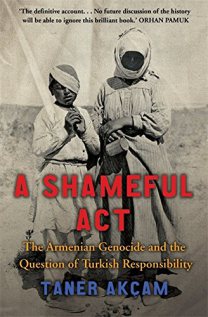
Taner Akcam’s A Shameful Act: The Armenian Genocide and the Question of Turkish Responsibility presents evidence to undermine every one of these arguments. Continue reading

Bernard Lewis and the Armenian Genocide Question

By Kyle Orton (@KyleWOrton) on June 7, 2015

In 2012, Bernard Lewis published his memoirs, Notes on a Century: Reflections of a Middle East Historian, which included a chapter on the court case brought against him in France in the 1990s for refusing to agree that the massacres of Armenians in the Ottoman Empire in 1915-16 constitute genocide in the original sense of the term, as applied to the Nazi Holocaust of European Jewry. The chapter is reproduced below.

Continue reading

Book Review: A Shameful Act (2006) by Taner Akcam, Part 2

By Kyle Orton (@KyleWOrton) on June 4, 2015

1

Part 1 of this review dealt with the question of whether the 1915-16 Armenian massacres constitute genocide. This part is about the post-war trials and the Nationalist Movement. Part 3 gives some conclusions on what went wrong in the Allied efforts to prosecute the war criminals and the implications for the present time. Alternatively, the complete review is available here.

The First Phase of the Trials

On October 30, 1918, the Ottoman Empire signed its final treaty of defeat. The Ottomans’ long decline began in 1683, and by 1844—not the 1830s, as Akcam slightly strangely says—the Empire was referred to as the “sick man of Europe”. The armistice was a near-total surrender, allowing the occupation of any area the Allies deemed necessary for their security. Unfortunately, it was neither the end of the war nor the end of the massacres against the Armenians.

The Allies—Britain, France, and Russia—issued a declaration on May 24, 1915, saying:

In light of the crimes against humanity and civilisation committed by Turkey, the allied powers warn the Sublime Porte that members of the Ottoman government involved in the mass murder will be held personally responsible for these crimes.

Not coincidentally, Akcam remarks, within days of this the official deportation law was passed through the Ottoman Parliament and would thereafter be issued by the Interior Ministry as legal cover for the CUP’s actions. The Allied statement was a first introduction of the concept of crimes against humanity, and of individual responsibility that extended to senior Generals and Heads of State. The Russians fell to the Communists and for reasons of realpolitik the French and Italians soon dropped their demands for punishing the Turkish war criminals, but the British were relentless. Continue reading

The Islamic State Officially Expands to Afghanistan

By Kyle Orton (@KyleWOrton) on 26 January 2015

The spokesman of the Islamic State (ISIS), Abu Muhammad al-Adnani, gave a speech today entitled, “Say, ‘Die in Your Rage’,” which is drawn from a Surah of the Qur’an [3:119]. The main announcement from Adnani is the acceptance of another wilayat (province), i.e. foreign branch of IS, this time in Afghanistan, led by Hafiz Saeed Khan, a former Tehrik-i-Taliban Pakistan (TTP) or “Pakistani Taliban” commander who broke away and formed a pro-ISIS faction in October. This follows the first declaration on this matter a month ago by IS’s caliph, Abu Bakr al-Baghdadi, which accepted “provinces” from Saudi Arabia, Yemen, Egypt, Libya, and Algeria. Adnani went on to make the foredoomed request that the Afghan jihadists “abandon disunity and factionalism” in order to join ISIS. Continue reading